ETL VBox
ETL VBox is the data backbone of the VBox Software Suite — a high-performance pipeline engine purpose-built for the demanding data volumes, quality requirements and processing deadlines of financial institutions. It handles every stage of the data lifecycle: extraction from heterogeneous source systems, algorithmic transformation and enrichment, rigorous validation, and delivery into the VBox calculation engines or downstream consumers.
Unlike generic ETL tools that treat financial data as just another payload, ETL VBox is designed from the ground up with domain awareness. It understands financial instrument hierarchies, counterparty structures, accounting period boundaries and regulatory reporting calendars. This tight integration with the VBox Suite — IFRSBox, Profit VBox, Risk VBox — means that data pipelines are not bolted on; they are an integral, first-class component of the platform.
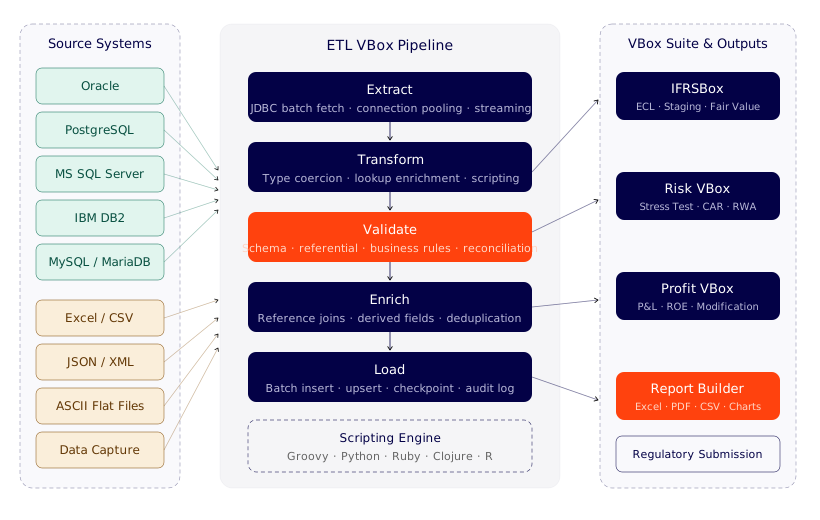
ETL VBox architecture: source system extraction, transformation and validation pipeline, job orchestration layer, and delivery into the VBox calculation engines
Data Import: Source Agnostic
ETL VBox connects to virtually any data source a financial institution operates. The extraction layer is built on native JDBC drivers with connection pooling, automatic retry and configurable fetch sizes — optimised for bulk extraction from production databases without impacting source system performance.
Supported Databases
ETL VBox provides native, optimised connectivity for the major relational database systems deployed across the banking sector:
Oracle Database — including support for Oracle-specific types (CLOB, BLOB, XMLType), partitioned table extraction, and DB Link traversal for cross-instance queries
PostgreSQL — with COPY protocol support for maximum throughput bulk extraction
Microsoft SQL Server — including Windows-integrated authentication and linked server access
IBM DB2 — z/OS and LUW editions, with EBCDIC encoding handling for mainframe sources
MySQL / MariaDB — with replication-safe read isolation
Sybase ASE / SAP ASE — legacy core banking system connectivity
Firebird — lightweight embedded database support
All database connections support DB Links and remote table access for federated queries across instances, as well as row-by-row transfer mode for scenarios requiring record-level transformation or validation during extraction.
File-Based Sources
Beyond relational databases, ETL VBox ingests data from the full range of file formats encountered in financial operations:
Microsoft Excel (.xlsx, .xls) — with intelligent header detection, multi-sheet extraction, named range support and formula evaluation
CSV / TSV — with configurable delimiters, quoting rules, encoding detection (UTF-8, ISO-8859, Windows-1252) and handling of malformed rows
JSON and XML — with XPath/JSONPath extraction, schema validation and nested structure flattening
Fixed-width ASCII flat files — with column-map definitions for legacy mainframe and core banking exports
Data Capture Sheets — browser-based upload forms for manual data entry where source system extraction is not available, with field-level validation and approval workflows
Transformation, Validation and Enrichment
Raw data from source systems is rarely ready for financial calculation. ETL VBox provides a comprehensive transformation engine that operates at wire speed:
Transformation Pipeline
Each ETL job defines a processing pipeline of transformation steps that execute in sequence on the extracted data:
Type coercion and normalisation — date format harmonisation, currency code standardisation, numeric precision alignment
Lookup enrichment — joining reference data (counterparty master, instrument classification, sector codes, rating mappings) from VBox’s internal reference tables or external sources
Algorithmic transformation — custom business logic implemented in the embedded scripting engine (Groovy, Python, Ruby, Clojure, R) with full access to the VBox data model and Java libraries
Derived field computation — calculated columns, aggregations, period-over-period deltas, conditional logic
Deduplication and conflict resolution — configurable strategies for handling duplicate records, overlapping date ranges, and conflicting source values
Validation Engine
Every record passes through a configurable validation layer before it reaches the VBox calculation engines. Validation rules are defined declaratively and execute at pipeline speed:
Schema validation — data type, nullable, length, precision, enumeration constraints
Referential integrity — foreign key existence checks against VBox master data (counterparties, instruments, accounts)
Business rules — domain-specific plausibility checks (e.g. maturity date after origination, interest rate within bounds, exposure amount non-negative)
Cross-record consistency — balance reconciliation, portfolio completeness checks, duplicate detection
Temporal validation — period boundary checks, backdating detection, sequence integrity
Failed records are routed to a configurable error handling pipeline: reject and log, quarantine for manual review, apply default values, or halt the job. Every validation failure is recorded with full context — source record, rule violated, field values — for audit and remediation.
Data Export and Report Generation
ETL VBox is not just an ingestion engine. It is equally capable on the output side — generating structured data exports, regulatory submissions and formatted reports.
Database Export
Processed data can be written to any supported RDBMS target using optimised batch insert with configurable commit intervals, upsert (insert-or-update) semantics, and truncate-and-reload patterns. Target table DDL can be auto-generated from the pipeline schema.
Excel Report Builder
ETL VBox includes a full-featured Excel report generator that produces publication-ready workbooks directly from pipeline data or VBox calculation results:
Template-driven rendering — define report layouts in Excel templates with placeholder markers; ETL VBox populates data, applies formatting and generates the final workbook
Multi-sheet reports — portfolio summaries, drill-down detail sheets, pivot tables, and chart sheets in a single workbook
Dynamic charts — line, bar, area, scatter and combination charts generated programmatically from result data, with configurable series, axes, titles and formatting
Conditional formatting — RAG (red/amber/green) status indicators, threshold-based highlighting, data bars and colour scales
Regulatory report formats — pre-built templates for CBN, ECB and Basel reporting schedules, with automatic period stamping and submission metadata
All Excel output is generated server-side in the native OOXML format — no Excel installation required. Reports can be attached to scheduled jobs for automatic generation and distribution.
File Export
Structured data export to CSV, JSON, XML and fixed-width formats with configurable encoding, delimiters, headers and compression (gzip, zip). Supports streaming export for large datasets that exceed memory capacity.
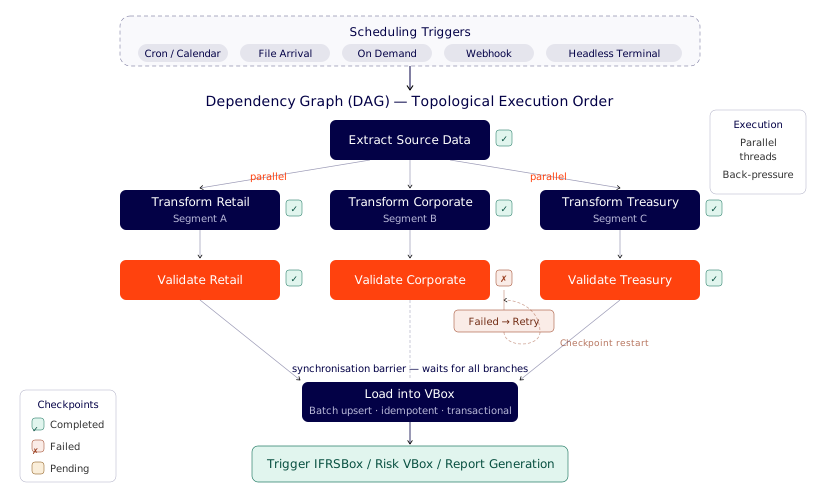
Job orchestration engine: dependency graph resolution, parallel execution with resource management, checkpoint-based restart and comprehensive monitoring
Job Scheduling and Dependency Resolution
Financial data processing is not a single pipeline — it is a directed graph of interdependent jobs that must execute in the correct order, on schedule, with guaranteed delivery. ETL VBox’s orchestration engine manages this complexity.
Dependency Graph Resolution
ETL jobs are defined with explicit dependency declarations: “Job B requires Job A and Job C to have completed successfully before it can start.” The orchestration engine resolves these declarations into a directed acyclic graph (DAG) and computes the optimal execution plan:
Topological ordering — jobs are scheduled in dependency-safe order, ensuring no job starts before all its prerequisites have completed
Parallelism extraction — independent branches of the DAG execute concurrently, maximising throughput on multi-core infrastructure
Cycle detection — circular dependencies are detected at definition time and rejected, preventing deadlock at runtime
Dynamic fan-out — a single parent job can spawn multiple child jobs (e.g. one per portfolio segment, one per currency, one per subsidiary) that execute in parallel and join at a synchronisation barrier before downstream processing continues
The dependency graph is visible in the ETL Builder UI as an interactive DAG visualisation, allowing operators to inspect the execution plan, identify bottlenecks and understand the critical path.
Scheduling
Jobs can be triggered through multiple scheduling mechanisms:
Cron-based scheduling — standard cron expressions for periodic execution (daily, weekly, month-end, quarter-end) with calendar-aware date arithmetic that handles business days, holidays and regulatory reporting deadlines
Event-driven triggers — jobs can be triggered by file arrival (file watcher), database change detection, or completion of upstream jobs in external systems via webhook or message queue
On-demand execution — interactive launch from the VBox UI with configurable runtime parameters (reporting date, portfolio scope, scenario selection) that can be set by the operator at start time
Headless terminal mode — autonomous execution via command-line invocation for integration into enterprise job schedulers (Autosys, Control-M, cron) without requiring a UI session
All scheduling modes support parameterised execution: the same job definition can be invoked with different parameters (e.g. different reporting dates, different portfolio perimeters) without duplication.
Restart and Recovery
Financial data pipelines cannot afford to restart from scratch after a failure three hours into a five-hour run. ETL VBox implements a checkpoint-based restart mechanism:
Step-level checkpointing — each completed pipeline step is recorded in a persistent job log. On restart, the engine resumes from the last successfully completed checkpoint, skipping all previously completed work
Idempotent operations — all database write operations are designed for safe re-execution: upsert semantics, transactional batching and automatic rollback of incomplete commits ensure that restarting a failed job does not produce duplicate records or corrupt data
Selective retry — operators can restart individual failed steps within a job without re-executing the entire pipeline, or resubmit only the failed records from a validation step after manual correction
Automatic retry with backoff — transient failures (network timeouts, database lock contention, temporary file system unavailability) trigger configurable automatic retry with exponential backoff before escalating to failure status
Failure isolation — in a parallel fan-out, the failure of one branch does not abort sibling branches. Successful branches complete and checkpoint; only the failed branch requires restart
Every restart decision is logged with full context: who initiated it, what was skipped, what was re-executed, and what the outcome was. This creates a complete operational audit trail for regulatory and internal governance purposes.
Scripting Engine
ETL VBox embeds a polyglot scripting engine that allows custom transformation logic to be written in the language best suited to the task:
Groovy — the primary scripting language, with native Java interoperability and full access to the VBox object model, JDBC connections and Java libraries. Groovy scripts compile to JVM bytecode and execute at near-Java speed
Python — via Jython integration, for teams with Python expertise or for leveraging Python’s data manipulation libraries
Ruby — via JRuby, for compact transformation logic and text processing
Clojure — for functional transformation patterns and concurrent processing
R — for statistical transformations, model scoring and analytical computations within the pipeline
Scripts execute within the ETL pipeline with full transactional context: they can read from and write to any connected database, access VBox calculation results, invoke VBox APIs and raise validation errors that route records to the error handling pipeline.
The ETL Builder provides a full-featured script editor with syntax highlighting, auto-completion, inline documentation and interactive debugging.
Low-Level Implementation and Performance
ETL VBox is engineered for the data volumes and processing windows of production banking environments. The implementation makes deliberate architectural choices that prioritise throughput, predictability and operational robustness.
Architecture
The engine is implemented in Java, running on the JVM with direct access to the VBox Suite’s internal data model and calculation APIs. This is not a separate middleware layer with serialisation overhead — ETL VBox operates in the same process space as the VBox engines, eliminating network round-trips and data format conversion for internal data delivery.
Performance Characteristics
Batch-optimised JDBC — bulk extraction uses server-side cursors with configurable fetch sizes (typically 5,000–50,000 rows per network round-trip), minimising driver overhead and network latency. Bulk inserts use JDBC batch mode with configurable commit intervals
Streaming architecture — data flows through the transformation pipeline in a streaming fashion; records are extracted, transformed, validated and loaded without materialising the entire dataset in memory. This enables processing of datasets that exceed available RAM
Parallel pipeline execution — independent pipeline stages execute concurrently on separate threads, with back-pressure flow control to prevent fast producers from overwhelming slow consumers
Connection pooling — database connections are pooled and reused across pipeline steps, with configurable pool sizes, idle timeouts and connection validation. Source system connections are isolated from target system connections to prevent cross-contamination of transaction states
Minimal overhead — the engine adds negligible processing overhead to the raw data transfer time. For bulk database-to-database transfers, throughput is bounded by network bandwidth and database I/O, not by ETL processing
Memory-efficient — large object handling (CLOBs, BLOBs, documents) uses streaming reads rather than full materialisation, keeping the JVM heap footprint predictable and bounded regardless of individual record size
Documentation and Governance
Every aspect of the ETL configuration is stored, versioned and auditable:
Human-readable XML definitions — all ETL job definitions, pipeline configurations, transformation rules and scheduling parameters are stored as structured XML files that can be inspected, compared and reviewed without specialised tooling
Integrated revision control — built-in Git-based version control tracks every change to ETL definitions with full history, diff capability and rollback. Changes can be tagged, branched and merged following standard development workflows
Integrated ETL Builder — a visual editor for constructing, testing and debugging ETL pipelines without requiring direct XML editing. The builder provides a graphical view of pipeline stages, data flow, dependencies and execution history
PDF export — complete ETL documentation can be exported to PDF for inclusion in audit packs, regulatory submissions and operational manuals
Execution logging — every job execution is recorded with start/end times, record counts, error counts, parameter values, checkpoint status and operator identity. Logs are queryable and exportable for operational analysis and regulatory evidence