PROFIT VBox
Software for the simulation and reporting of IFRS compliant Profitability after all cost — ex ante or ex post as per single instrument. The objective is to report the Actual Performance as per Contract, Customer, Profit Centre, Product or Segment exactly as it will be recognized in the Statement of Comprehensive Income (P&L) so that there will be only one consistent version of the truth.
Return on Equity
The Basel Accords define minimum Capital Requirements for all Financial Assets and thus limit the Bank’s Exposure and Business Activities based on the available Capital. Thus Capital should be optimal allocated in profitable ventures only.
PROFIT VBox will calculate the Income and the Attributable Cost of any Financial Asset or Liability in order to calculate the Return on Equity after Compensation of the Share Holders.
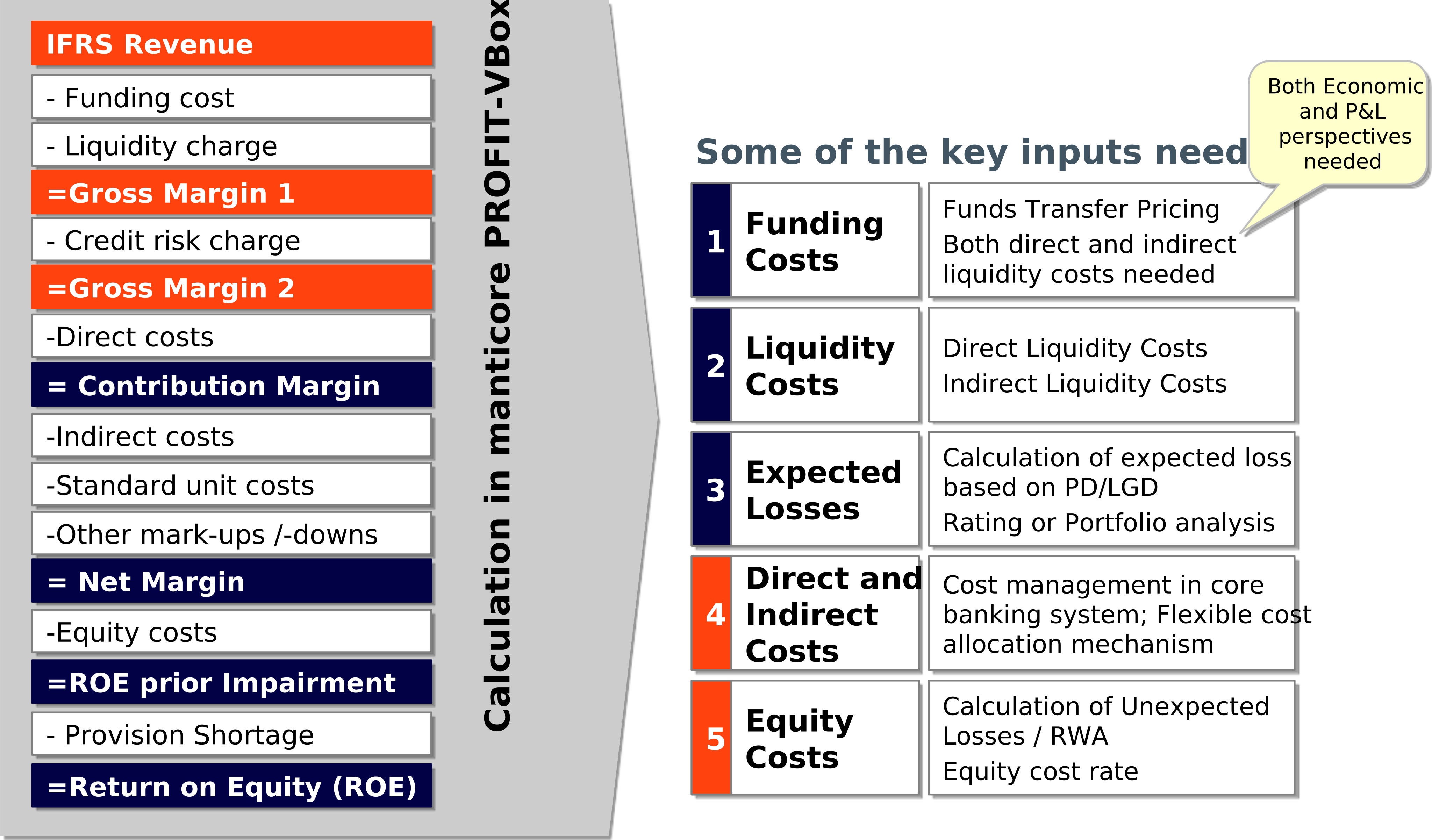
Return on Equity Calculation
Contract Modification
When a contract is restructured on behalf of a distressed customer in order to ease the debt service, then the P&L impact of this modification will need to be recognized as a cost (similar to a subsidy or a partial write off). This cost is the difference between the Book Value before modification and the Present Value of the modified Cash Flows (discounted at the original EIR before modification).
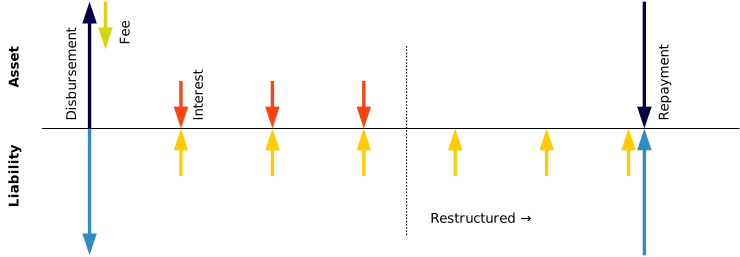
Interest Waiver
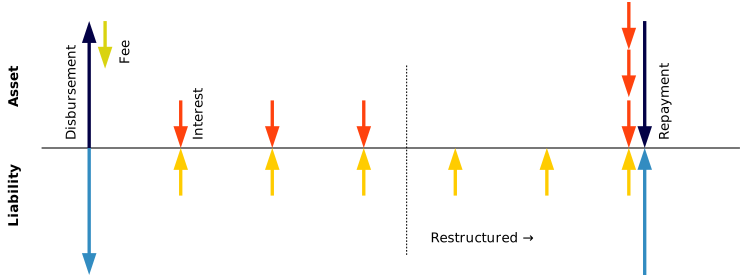
Interest Moratorium
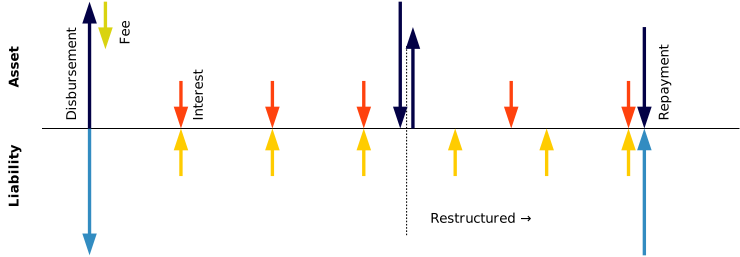
Liquidation
Profit VBox will:
generate the Original Contracts and Cash Flow Schedules before Modification
calculate the EIR and Amortised Cost (Book Value) of the Contract on Modification Date
interactively simulate the Modification (e.g. Moratorium, Waiver)
distribute the modified Cash Flows across the Original Contracts and
discount the distributed Cash Flows down to the Present Value as per Original Contract
print an Application with the Modification Details which can be authorized by the decision makers (alternatively, there is an Electronic Workflow)
Best practise is to Simulate the Modification before it is agreed on (ex-ante). Although Profit VBox also supports the Calculation ex-post after the Modification has been agreed.
Stress Testing
Regulatory stress testing requires banks to quantify the impact of severe but plausible economic shocks on their credit portfolios. IFRS VBox implements a complete, automated stress testing pipeline — from shocked macroeconomic covariates through to probability-weighted Expected Credit Losses and Capital Adequacy impact.
The methodology follows the perfect foresight approach used in ECB supervisory stress tests: a defined macroeconomic scenario is applied to the portfolio without management overlays or mitigation assumptions, and the resulting credit losses are computed deterministically through the IFRS 9 framework.
From Macroeconomic Shocks to Stressed PDs
The starting point of every stress test is a macroeconomic scenario: a set of shocked covariates describing a plausible adverse economic environment over a multi-year horizon. Typical covariates include GDP growth, unemployment rates, interest rates, exchange rates, commodity prices (e.g. oil), and sector-specific indices.
VBox translates these macroeconomic shocks into credit risk parameters using satellite regression models that link each segment’s Point-in-Time Probability of Default (PD PIT) to the relevant macroeconomic drivers:
where s denotes the portfolio segment and t the projection year. The regression coefficients are estimated from historical data, capturing the empirically observed sensitivity of default rates to each macroeconomic driver.
The result is a term structure of stressed PD PIT for each segment and each scenario — typically spanning 1 to 3 years — which forms the input to the staging and ECL calculation engine.
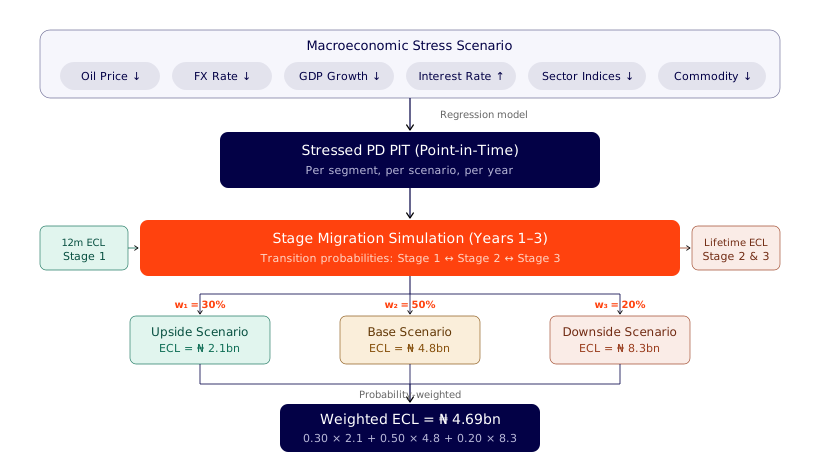
End-to-end stress testing pipeline: macroeconomic scenario → stressed PD PIT → stage migration simulation → probability-weighted ECL
Stage Migration Simulation
Under IFRS 9, the ECL for a financial instrument depends critically on its stage classification:
Stage 1 (Performing): No significant increase in credit risk since origination. Provision = 12-month ECL.
Stage 2 (Underperforming): Significant increase in credit risk, but not yet credit-impaired. Provision = Lifetime ECL.
Stage 3 (Default / Credit-impaired): Objective evidence of impairment. Provision = Lifetime ECL.
A macroeconomic shock changes the probability of default, which in turn changes the likelihood that instruments will migrate between stages. This migration is the primary driver of the ECL cliff effect under stress — as exposures move from Stage 1 (12-month ECL) to Stage 2 or 3 (Lifetime ECL), the provisioning requirement can increase by an order of magnitude.
VBox simulates the stage migration dynamics over a 3-year horizon using the stressed PD PIT:
Transition matrix estimation: For each projection year, VBox derives a stage transition probability matrix from the stressed PDs. The matrix captures the probability of migrating from any stage to any other stage (including cures from Stage 2 back to Stage 1, which become increasingly rare under stress).
Year-by-year propagation: The portfolio’s stage distribution at each year-end is computed by applying the transition matrix to the prior year’s distribution. This captures the compounding effect of sustained stress — a moderate annual downgrade rate produces a dramatic cumulative shift in portfolio composition over 3 years.
Exposure-level staging: Each individual exposure is assigned a stage at each projection point based on its segment’s transition probabilities and its individual risk characteristics (e.g. days past due, restructuring flags, sector, insider-related status).
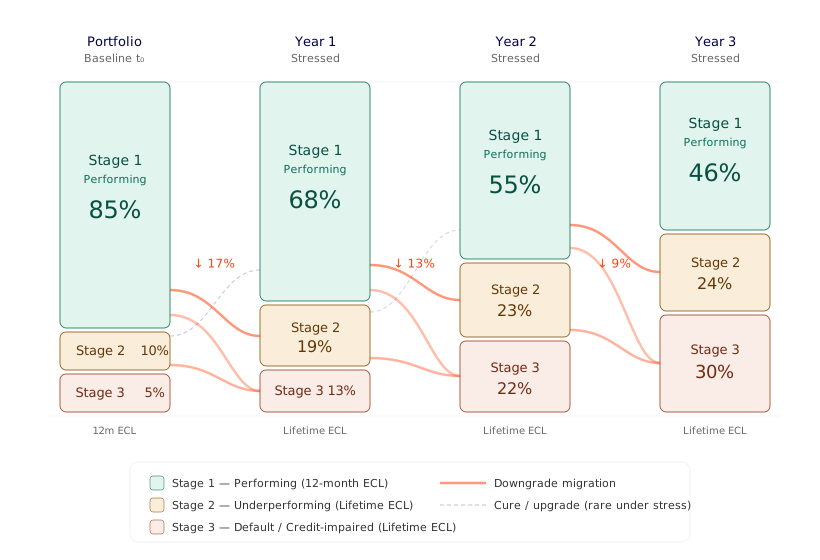
Simulated stage migration under a macroeconomic stress scenario: progressive deterioration of the portfolio composition over a 3-year horizon. Curved paths show migration flows between stages; downgrade migration accelerates under sustained stress while cure rates diminish.
The diagram illustrates a characteristic stress pattern: Stage 1 (Performing) declines from 85% to 46% over three years as exposures progressively migrate to Stage 2 and Stage 3. The downgrade flow is initially concentrated in the Stage 1 → Stage 2 transition (significant credit risk increase), but the cumulative effect of multi-year stress drives a substantial share of the portfolio into Stage 3 (default) by Year 3.
From Staged Portfolio to Probability-Weighted ECL
Once the stage distribution at each projection year is known, VBox computes the ECL for each exposure at each stage:
where:
PD is the stressed Probability of Default (12-month for Stage 1, lifetime cumulative for Stages 2 and 3)
LGD is the Loss Given Default, adjusted for collateral haircuts under the stress scenario
EAD is the Exposure at Default, including undrawn commitments and off-balance sheet items
The portfolio-level ECL under each scenario is the sum across all exposures. For forward-looking IFRS 9 compliance, VBox computes the probability-weighted ECL across multiple macroeconomic scenarios:
where \(w_k\) is the assigned probability weight for scenario \(k\) (e.g. 30% upside, 50% base, 20% downside) and \(\text{ECL}_k\) is the total ECL computed under that scenario.
This probability-weighted approach ensures that the reported ECL reflects the bank’s best estimate of expected losses across a range of plausible futures — as required by IFRS 9’s forward-looking impairment model.
Impact on Capital Adequacy
The stressed ECL directly affects the bank’s Capital Adequacy Ratio (CAR) through two channels:
Increased loan loss provisions reduce retained earnings and thus Tier 1 capital.
Stage migration increases risk-weighted assets (RWA) as exposures in worse stages attract higher risk weights.
VBox reports the full capital impact chain: pre-stress CAR, post-stress CAR, and capital shortfall — exactly as required by regulatory frameworks such as the CBN’s March 2026 circular or the ECB’s supervisory stress test methodology.
Why Automation Matters
The iterative nature of stress testing — multiple scenarios, sensitivity analysis, scenario calibration — makes automation essential. VBox executes a full portfolio stress run in minutes, enabling banks to:
Sweep 10–15 macroeconomic scenarios to map the full CAR impact surface
Isolate individual risk drivers (oil price vs. FX vs. sector stress) to understand which factors dominate the capital outcome
Identify threshold boundaries where the bank’s CAR crosses regulatory minimums
Pre-validate results against the regulator’s likely assumptions before submission
A manual process produces one result in weeks. An automated platform produces the understanding to make that result defensible.